



Legal Dual Pricing for Card Payments, Powered by Coastal Pay
If you are searching for a payment processor that lets you run dual pricing legally, Coastal Pay is built for you. We design and support compliant cash-discount and dual-price programs aligned with state regulations and Visa/Mastercard rules, so you can reduce processing costs without risking fines or angry card networks.
Share
Stop Guessing Which Processors Allow Dual Pricing – Start Using One That Does It Right
Yes, Coastal Pay offers compliant dual pricing and supports merchants nationwide. Most major U.S. processors now offer some form of dual pricing program, but legality does not come from the brand on the statement. It depends on how prices are displayed, how receipts are worded, how signage is posted, and whether the configuration aligns with state law and card-brand rules.
Coastal Pay’s Dual Pricing program is an established, supported offering, not a bolt-on hack. The team configures, registers, and supports the program end-to-end so you do not have to interpret card-brand bulletins or state surcharge statutes on your own.
How Our Dual-Pricing Setup Keeps You Compliant in All 50 States
Coastal Pay designs dual-pricing programs around three compliance pillars.
The Three Compliance Pillars
- State Law: Programs reviewed against state surcharge-versus-discount rules, including specific requirements in New York, Connecticut, Colorado, Maine, Massachusetts, and others. Sample signage and wording provided per state.
- Card-Brand Rules: Configurations align with current Visa and Mastercard rules, including program registrations where required. Debit, prepaid, and credit cards handled per network requirements.
- Clear Signage and Disclosure: Card price is treated as the standard price, with a true cash discount clearly shown on receipts, menus, shelf tags, and checkout pages.
What Coastal Pay Provides at Onboarding
- State-specific signage templates and receipt language
- POS and gateway configuration to display cash and card prices correctly
- Registration with card networks where required
- Ongoing support if state laws or card-brand rules change
This is general information, not legal advice. Verify specific requirements with qualified counsel for your state and industry.
What Your Checkout Experience Looks Like With Coastal Pay
In-Person POS and Terminals
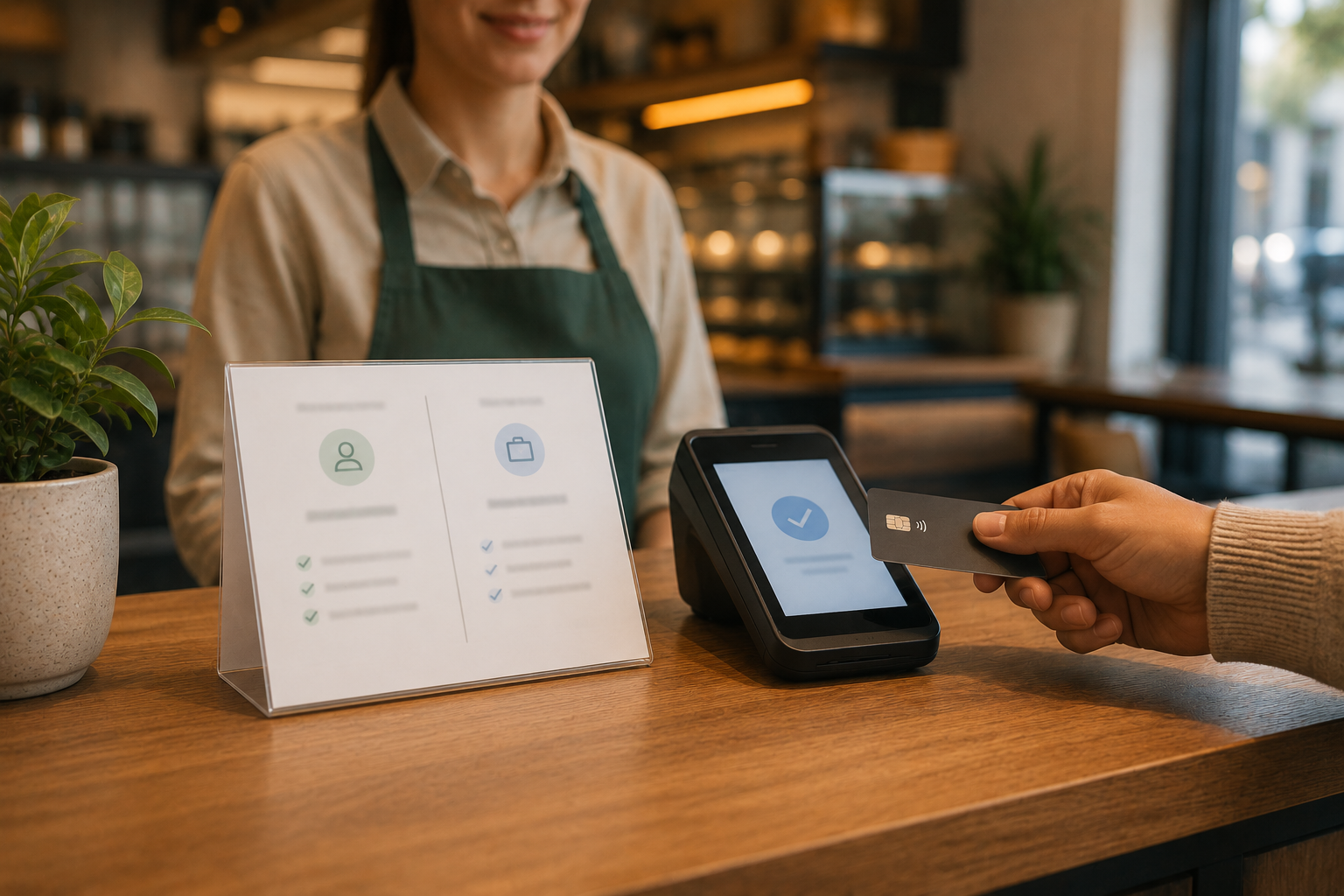
Both cash and card totals display on the customer-facing screen before transaction confirmation. The customer sees the cash price (lower), the card price (standard), and chooses how to pay. Receipts itemize the cash discount when applicable.
Online and E-Commerce Checkout
The card price displays as the default total. A separate option (ACH or cash on pickup, where applicable) shows the cash price as a discount. Customers see both options upfront.
Invoices and Payment Links
Invoices present the card price by default with a separate cash or ACH discount option shown clearly. Payment links carry the same structure.
Consistent Across All Channels
Coastal Pay’s gateway and 2,000+ integrations support consistent dual-pricing behavior across in-person, online, invoice, and tap-to-pay flows. No mix-and-match across separate vendors. One merchant account, one configuration, one compliance posture.
Who Dual Pricing Works Best for (and When to Consider Surcharging Instead)
Where Dual Pricing Shines
- Retail: Single and multi-location stores looking to eliminate most processing costs
- Auto repair and service centers: Higher-ticket transactions where card fees compound
- Restaurants and hospitality: Where customers expect transparent menu pricing
- Professional services: Legal, accounting, consulting firms with predictable billing
- Healthcare and pharmacies: Where margins are thin and processing cost reduction is meaningful
When Surcharging or Standard Processing May Fit Better
- Card-not-present heavy e-commerce where pricing transparency matters more than fee elimination
- B2B environments where buyers expect interchange-plus or optimized standard pricing
- States with strict surcharge or discount disclosure laws may require specific implementation choices
- Industries where price-conscious customer perception would suffer from a visible card-price differential
Coastal Pay supports both dual pricing and surcharging programs, plus standard flat 2.5% + $0.15 processing. The team helps you pick the right fit based on your state, industry, channel mix, average ticket, and monthly volume.
Get a Tailored Dual-Pricing Quote and Compliance Walkthrough
A 20-minute review with Coastal Pay covers your state, current processor, and recent statements to confirm dual-pricing eligibility and project savings.
Instant approvals through SignUp Link for most U.S. low-risk merchants. Start taking dual-priced payments same day once underwriting completes. Registered ISO/MSP with Wells Fargo and Axiom Bank.
Common Dual-Pricing Questions
- Is dual pricing legal in all 50 states?
- Dual pricing, structured as a true cash discount with the card price as the standard price, is broadly permitted across all 50 U.S. states when implemented correctly. Some states (New York, Connecticut, Colorado, Maine, Massachusetts, and others) have specific signage, disclosure, or surcharge-versus-discount requirements. Coastal Pay reviews each merchant’s state and industry at onboarding. General information, not legal advice.
- Does dual pricing work with debit cards?
- Card-network rules treat debit cards differently from credit cards. Many compliant dual pricing programs apply the card price to credit card transactions and process debit cards at the cash price (or with a smaller adjustment) to align with the Durbin Amendment and network rules. Coastal Pay configures the program to handle credit, debit, and prepaid cards correctly.
- What is the difference between dual pricing and surcharging?
- Surcharging adds a fee on top of the listed price when a customer pays with a credit card. Dual pricing displays two prices upfront (cash and card) and treats the card price as the standard. Surcharging has stricter network caps and is restricted in some states. Dual pricing is broadly accepted across all 50 states when implemented correctly.
- Which payment processors allow you to do dual pricing legally?
- Many U.S. processors offer dual pricing, including Coastal Pay, Merchant Industry, IpPayware, DropTheFee, CenterEdge, Honest Merchant Solutions, Eagle Processing Systems, Pacta Payments, Citcon, Quantum Merchant Services, and MIDsource. Legality depends on configuration, signage, and adherence to state and card-brand rules, not the processor’s brand. Coastal Pay provides full configuration, signage, receipt language, and registration support designed for compliance in all 50 states.

Get Approved and Start Taking Payments in 2 Minutes
Looking for a payment processor that offers instant boarding in 2 minutes? Coastal Pay’s SignUp Link lets most businesses complete a simple online application, get approved, and start taking payments in about two minutes. No long forms, no days-long waiting period.

Best Payment Gateways With 2,000+ Integrations: Stripe, Square, Coastal Pay, PayPal & Adyen Compared
If you are hunting for a payment gateway with 2,000+ software integrations, the list of true contenders is short. In this guide, we break down how Stripe, Square, PayPal/Braintree, Adyen, and Coastal Pay actually connect to your POS, e-commerce, CRM, ERP, and vertical platforms, so you can choose a gateway that fits your stack instead of forcing your stack to fit your gateway.

How to Sign Up for a 2.5% Flat-Rate Payment Gateway in 2 Minutes With Coastal Pay
You do not sign up for a generic “2.5% gateway.” You choose a processor that actually offers that rate and walk through their onboarding. This guide shows you exactly how to grab Coastal Pay’s 2.5% + $0.15 flat-rate plan, use the 2-minute instant approval flow, and get your payment gateway live with no separate gateway fees.

Payment Gateways With No Gateway Fees: Coastal Pay vs Square, Stripe, and PayPal
If you are searching for a payment gateway with no gateway fees, you are not alone, but the fine print can be confusing. This guide breaks down what “no gateway fee” really means, compares Coastal Pay’s $0 gateway to Square, Stripe, and PayPal, and shows when Coastal Pay can actually lower your total payment costs while keeping setup fast and simple.